
Horror Clown Mask: What Makes One Actually Frightening
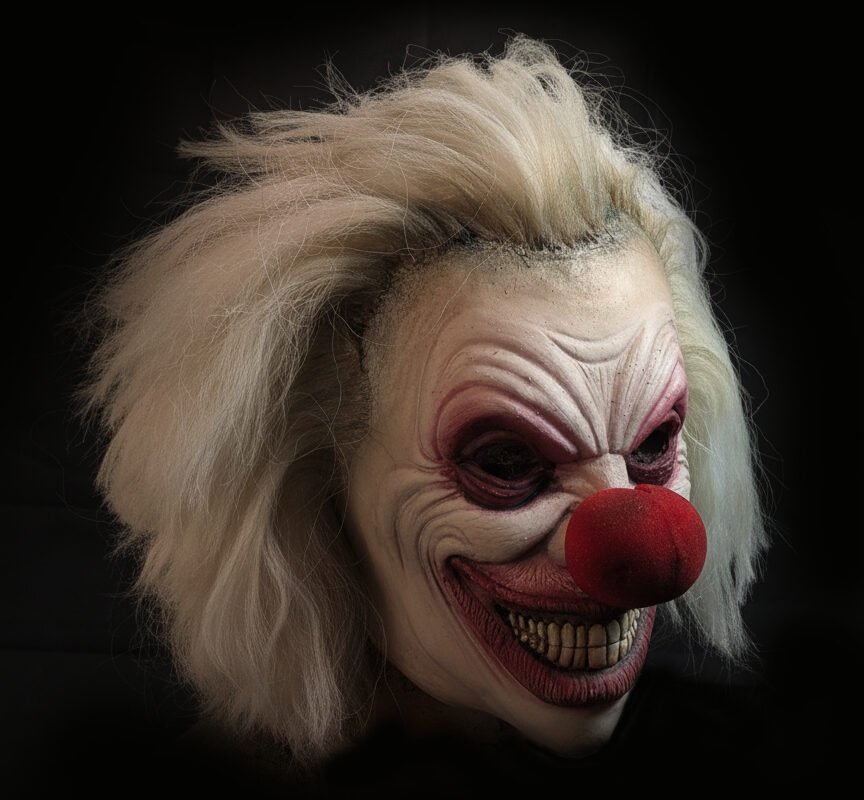
A clown mask is the hardest thing I make. Not technically. Technically a skull is harder, because bone has to be right or the whole thing reads as a toy. A clown is harder because the difference between frightening and comical is about two millimetres of paint at the corner of a mouth, and there is no way to know which side you landed on until you put it on a head and stand in a dark room.
If you are shopping for a horror clown mask, or thinking about sculpting one yourself, this is what I have learned about why some of them crawl under your skin and most of them just look like fancy dress.
Why the clown still works when almost nothing else does
Horror wears out. A monster that terrified people in 1985 gets a remake, then a parody, then a supermarket costume, and by the time it reaches the fancy dress aisle it has no teeth left. The clown has survived all of that, and it keeps coming back, because the fear does not come from the design. It comes from the contradiction.
A clown face is built entirely out of friendly signals. Wide smile. Big eyes. Bright colours. Rounded features. Every one of those is a thing a human face does when it means you no harm, exaggerated past the point where a real face could hold it. Your brain reads the signals, expects a person behind them, and finds a fixed expression that never changes no matter what happens next. That gap is the whole effect. It is why a clown standing perfectly still at the end of a corridor is worse than one running at you.
Which tells you something useful if you are buying one: the mask has to hold that contradiction. A clown mask that has simply been made to look evil, with fangs and blood and a scowl, has resolved the tension. It has told you what it is. It is a monster now, and monsters are easier to look at than something smiling at you for no reason.
What separates a good horror clown mask from a cheap one
The grin does the work
The mouth is where a clown mask lives or dies. Too symmetrical and it reads as a printed graphic. Too wild and it becomes a cartoon. What you want is a smile that is slightly wrong in a way you cannot immediately name, usually because one side sits higher than the other, or it stretches a fraction further back than a real mouth could.
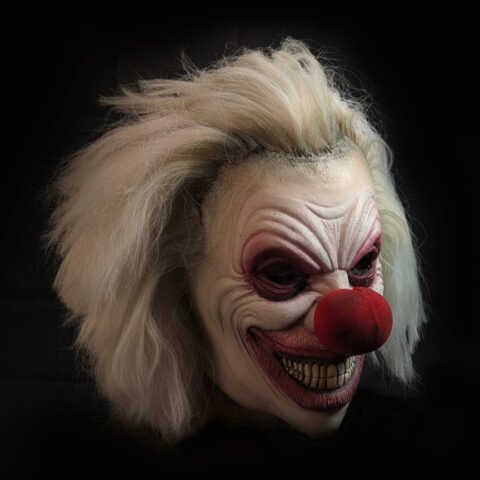
Teeth matter more than people expect. A mouth full of even, white, regular teeth looks like dentures. Irregular teeth, with gaps and different lengths and a bit of staining, read as real, and real is what makes it disturbing. The mask I cast has a wide, toothed grin for exactly this reason: the width is the joke, and the teeth are the threat.
Skin texture is the thing cheap masks skip
Look at any mass-produced clown mask and you will notice the surface is smooth. Perfectly, evenly smooth, because it came out of a mould designed for speed and a paint job designed for a spray line. Human skin is never smooth. It has pores, creases, blotches, thin patches over bone and heavier patches under the eyes.
Weathering a mask, which means building up layers of colour so the surface looks aged and lived in rather than painted, is the single biggest difference between something that looks like a costume and something that looks like a face. It is also the slowest part of the job, which is exactly why volume manufacturers leave it out.
Hair should look like it has been through something
Clown hair on a cheap mask is usually a wig: nylon, uniform, glued around the rim. It moves wrong and it catches light wrong. Crepe hair, the crimped fibre used in film and theatre work, sits differently. It tangles, it sticks out at angles, it looks like it has not been washed in a decade, and that dishevelment does a lot of the character work before anyone has looked at the face properly.
Latex, silicone, foam: what you are actually choosing between
Material decides more about how a mask behaves than most listings admit. Here is the honest comparison from someone who casts these.
Latex
Slip-cast latex is the traditional choice for full-head horror masks and still the right one for most people. It takes fine sculpted detail, it holds paint well, it is tough enough to survive a haunt season, and it costs a fraction of silicone. The trade-offs are real though: latex is warm to wear, it will perish eventually if you treat it badly, and it does not move with your face. For a clown that last point barely matters, because the whole idea is an expression that never changes.
Silicone
Platinum silicone is what you see in close-up film work. It translates light like skin, it flexes with the wearer, and it is astonishing on camera. It is also heavy, expensive, needs careful support to wear for any length of time, and tears if you are careless. For a collector’s piece or a film shoot it is worth it. For a haunt where you are on your feet for five hours, most people regret it.
Foam latex and vinyl
Foam latex is light and comfortable and used widely in professional makeup effects, but it is fragile and has a short usable life. Vinyl and PVC are what the supermarket masks are made from: cheap, light, and they look exactly as cheap as they cost. Nothing wrong with that if you need forty of them for a party.
Fit, sight lines and breathing: the part nobody photographs
This is the section I wish more mask listings had. A full-head mask has to solve three practical problems, and how it solves them decides whether you can actually wear the thing.
Sight lines. Eye openings are a compromise. Bigger openings mean you can see, and also mean anyone close can see human eyes looking out, which breaks the effect badly. Smaller openings preserve the illusion and reduce your vision to something like looking through a letterbox. A well-designed mask puts the openings where the sculpt hides them, often in shadow under a brow or inside a painted eye socket, so they can be generous without being obvious.
Breathing. Any full-head latex mask gets warm and humid fast. Open mouths help enormously, which is a happy accident for clown designs, since the grin is usually open anyway. If a mask has a closed mouth, check it has nostril openings or you will be taking it off every twenty minutes.
Head size. Latex has some give, but a full-head mask cast on a standard form will be snug on a large head and loose on a small one. If you are between sizes or wearing it over hair, ask before you buy. I would rather answer an email than have someone receive something that does not fit.
Wearing it so it actually frightens people
A good mask does maybe half the work. The rest is how you use it, and this is where most people undersell what they have bought.
- Stay still. The fixed expression is your asset. Movement invites people to read body language and body language is reassuringly human. Stillness leaves them with nothing but the face.
- Light it from below or the side. Overhead light flattens a sculpt and kills every bit of texture that was built into it. Low, raking light throws the weathering and the brow into relief.
- Cover the neck. The seam between mask and skin is the single biggest giveaway. A high collar, a ruff, or a costume that meets the mask line solves it in one move.
- Do not add blood. Tempting, and almost always a downgrade. Blood explains the horror. A clean clown face gives a viewer nothing to explain it with, and the unexplained thing is the one they think about later.
Looking after latex so it lasts
Latex fails from three things: light, heat and oil. Keep it away from all three and a well-made mask will outlast you.
- Store it stuffed with tissue or on a head form so it keeps its shape. Folded latex creases permanently.
- Keep it in the dark. UV is what turns latex brittle and yellow.
- Dust the inside with talc or cornflour before storing. It stops the surfaces sticking to themselves.
- Clean with mild soap and water, never solvents or oil-based products.
- Do not leave it in a car, a loft or anywhere else that swings between hot and cold.
Make one, or buy one?
Genuinely worth thinking about, and I say that as someone who sells them.
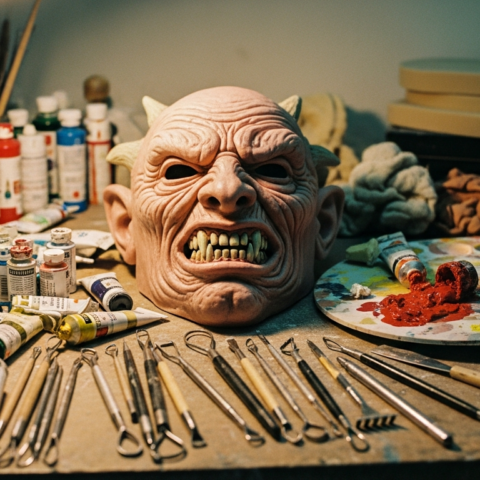
Make one if the process is the point. Sculpting a clown is a superb exercise precisely because of the difficulty I opened with: you will learn more about how faces read from one clown sculpt than from five monsters. If you want to try, the honest route is an oil-based clay sculpt over a head form, a plaster or silicone mould, and slip-cast latex. Expect the first one to be wrong. Expect to enjoy it anyway.
Buy one if you need it to work on a specific night. Sculpting, moulding, casting and painting a full-head mask is weeks of work and a fair bit of material cost before you have anything wearable, and the first attempt rarely is.
Our horror clown mask is hand-cast in latex, hand-painted with weathered skin detailing, and finished with crepe hair, made one at a time in our UK workshop. It is not the cheapest clown mask you will find, and it is not trying to be. It is trying to be the one that makes someone stop in a doorway.
The short version
A horror clown mask works when it keeps the contradiction alive: friendly shapes, fixed expression, nothing explained. Judge one on its grin, its skin texture and its hair, in that order. Choose latex unless you have a specific reason not to. Check how you will see and breathe through it before you commit. Then stand very still and let it do the work.



Comments 0
Log in to leave a comment.